

“The great flattening” pipedream returns as an AI-first hallucination
The CEOs who want to flatten the org seem ignorant of how the org works


In May 2026, controversial crypto exchange company Coinbase announced 14% of the company was to be laid off. CEO Brian Armstrong justified his decision in an all-company email which he later published on X. After paying the slightest lip service to the fact that the crypto industry is suffering a major slump, and without mentioning Coinbase had just disclosed its second consecutive quarterly loss and a 40% revenue shrinkage, Armstrong pulled out the “AI excuse” that is now so popular among the executive class:
AI is changing how we work. [...] The pace of what’s possible with a small, focused team has changed dramatically, and it’s accelerating every day.
Given this insight, a reasonable person might think, “Wow, if AI is accelerating what’s possible with fewer human workers, imagine what amazing things we will now achieve with all the employees we have?” but no, a CEO like Armstrong concludes: “Wow, if AI is accelerating what’s possible with fewer human workers, imagine how much we can lower our operating expenses if we lay off a bunch of human workers?” Somehow they arrive at this realization without surmising that the largest and least impactful operating expense of all is their own salary.
In order to put some lipstick on this uninspired idea, Armstrong talked about the layoffs as a “flattening” that would make work life better for remaining employees. It almost sounds like he’s describing a new democratic utopia emerging from years of stifling bureaucracy and inertia:
“Fewer layers, faster decisions: We are flattening our org structure to 5 layers max below CEO/COO. Layers slow things down and create coordination tax. The future is small, high-context teams that can move quickly.”
Business articles have circulated about “flattening” ever since Zappos made waves with their (mostly failed) “Holocracy” experiments in 2014. But in the age of AI being the perfect excuse for making job cuts, the idea has become more virulent and is known as “The Great Flattening.” What this amounts to is essentially deleting all middle managers, leaving frontline managers as the only layer separating individual contributors from the C-suite. Which, as someone who has worked many long nights and years as an Engineering Manager, is a utopia I can almost believe in. Let’s face it, one of the biggest challenges faced by any line manager is how to protect your direct reports from flak from on high while managing up to middle managers who are usually just a little too far removed from the day-to-day work to have any empathy for you or your team. If anyone in your organization is going to make you feel worthless through micromanagement, narcissistic mind games, political manipulation, or outright gaslighting and bullying, it’s going to be a middle manager, especially in the tech field. Why? Because many people promoted to this level are smart but performative ass kissers chasing the higher salary rather than giving a shit about any of the employees under their purview. Most of them were never given any leadership training and have no real people skills. I won’t lie: many of the middle managers I’ve encountered in my career were overpaid douchebags who took out their own problems on everyone below them. Some of them were narcissists or had less backbone than Marco Rubio.
But I’m not a CEO who can’t imagine a world outside his own anecdotal experiences, so I can see that managers are more than just numbers in a payroll system. There is a purpose to the hierarchy, even if it’s often obscured or abused. While I was an Engineering Manager I had some terrible managers for sure, but I’ve also worked for enough good managers to understand how middle management is supposed to work. The bad managers set bad examples that leave psychological scars — which I’m not excusing — but the good managers taught me what true leadership looks like.
Middle managers disambiguate. On a good day, a middle manager should act as a communication and prioritization layer. They’re a filter that, when working as intended, turn messy, unrehearsed memos and mandates from the C-suite into relatable and actionable guidance and next steps for teams. They’re in the unenviable position of figuring out how the real work of the company aligns with the grand vision of people who are so far removed from the daily work they may as well be living on another planet. They help temper expectations at the top, advocating for their teams to get the resources and budget allocations they need. And they provide mentorship to line managers — whose shoes they’ve already walked in. In a healthy organization, middle managers are line managers who have been promoted because they were well respected and demonstrated an ability to lead and inspire teams. Now they get to multiply the effectiveness of the people around them within a larger sphere of influence.
Even if your experience with middle management has not been good, I’m arguing that they’re still a necessary evil. A corporate workplace without middle managers is a recipe for disaster. A few (not exhaustive) reasons why:
An unfiltered C-suite is a crippling distraction.
Without middle managers, line managers are overburdened and overstressed.
In the absence of formal hierarchy, unofficial tribes form anyway.
“Flattening” is doublespeak for Authoritarianism.
An unfiltered C-suite is a crippling distraction
Frontline managers need a buffer between them and the CEO. CEOs are generally not known for their unwavering adherence to roadmaps, patience for strategies to pay off, or even mental congruence with baseline reality. What they are known for is an almost child-like excitement for new ideas, strategic pivots, and performative decision making that often seems disconnected from what really matters.
One of the tasks of high level directors and middle managers is to somehow keep this creative but also chaotic force in check so that it doesn’t ripple through the company, impinging momentum or morale. Even level-headed CEOs who play to their strengths and are able to commit to long-term plans are still prone to distracting their company with too many ideas at once. It may seem counterintuitive, but constantly throwing new ideas at the organization leads to stifling inertia and indecision, not more innovation or guaranteed growth. There’s an interview with Jeff Bezos where he reminisces about a mentor who told him “you have enough ideas to destroy Amazon”, meaning his propensity to fill up a whiteboard with thought bubbles did more harm than good without a proper framework and process to distill, organize, and prioritize those ideas in a sensible way that didn’t distract the whole company and jeopardize existing goals.
You can’t do this without a middle management layer. Imagine trying to be the frontline manager who’s responsible for providing clarity, direction, and motivation to your team while simultaneously being pulled in the direction of every new idea that comes down from the top, no matter how out of left-field it might be? It’s completely untenable. Translating and tempering C-suite fantasies and whims into realistic goals that fit into the normal cadence and operating flow of the company can be a full-time job in of itself. Absent this corporate safety valve, frontline employees would just drown in the blast from the innovation firehose and would be forced to neglect so much of what they’re supposed to be responsible for. It’s true that long-term success requires a certain amount of change and transformation, but it also requires balance, focus and consistency. It requires prolonged investment in what works, not just experiments in what could.
Without middle managers, line managers are overburdened and overstressed
Point two directly follows my first point above. Without the necessary filtering layer between the C-suite and team managers, you are placing an enormous burden on people leaders responsible for the day-to-day operation of their teams to also find time to be CEO/CTO/CFO whisperers, and this is never going to work.
Leaders will own much more, with as many as 15+ direct reports.
This is just basic math. If middle management is gone, and the company is not hiring more frontline managers, existing frontline managers have to take on more direct reports and more responsibility overall. I can’t say this has ever been a good deal for managers or their teams. As if that wasn’t bad enough already, Armstrong piles on:
No pure managers: Every leader at Coinbase must also be a strong and active individual contributor
So let me get this straight: not only does he want line managers to do the work of middle managers, but they’ve got to take on some of the work of their direct reports as well? At the same time as having their number of direct reports double or triple. In what insane multiverse could this directive possibly make any sense? In what reality does this not lead to flawed and hurried decision-making, survival-first short-term thinking, as well as physical and mental burnout? It seems painfully obvious and yet these obtuse CEOs keep rehashing the same memo like it’s some sort of new gospel.
Readers of Humanware know that the IC vs manager misunderstanding is one of my pet peeves. An Engineering Manager doesn’t need to be the smartest person in the room and the most experienced developer on their team. That’s not the point or the purpose of being a people leader. And in fact, if you are the lead developer and a manager at the same time, it can be pretty detrimental to your direct reports. Writing code, managing direct reports, and managing up are three distinct skill sets that very few professionals are ever going to be able to master while maintaining a clear head and balanced view. And fewer still can find equilibrium between the extreme context switching, mental acuity, and political prowess that would be required to excel under such pressure.
In a world where the EM is acting as an IC as well as trying to manage multiple developer pods as well as reporting up to the C-suite — trying to translate their ideas, frustrations and tantrums into projects and meaningful improvements — some part of that equation has to fall by the wayside. Every manager will handle this differently, depending on their experience, comfort zone, and temperament, so in some cases you’ll get managers who are too heads down in their own code to care about stewarding team processes or improving team throughput, while others might decide the most important aspect of their job is sucking up to the C-suite while ignoring the legitimate questions or concerns of their direct reports. Either way, the overburdening of management leads to more ruthless prioritization as a sort of survival mechanism, which inevitably leads to apathy or neglect in other important areas.
Layering on new responsibilities and conflicting priorities for line managers ignores the many hats they already need to wear. Managers don’t just conduct 1:1’s and issue raises, they also act as hiring managers, delivery managers, cross-functional point person, meeting facilitator, a cultivator of company and team culture, a farmer of technical debt, a stakeholder synergist, a ceremony czar, an effective squeaky wheel, an advocate, a mentor, and an umbrella for political or systemic issues that could impact the morale or the efficiency of the team. One of the keys to building teams that go from storming to performing is a great manager that becomes the glue and the conduit. Not a manager who is too distracted and too overburdened to pay attention to what matters.
In the absence of formal hierarchy, unofficial tribes form anyway
In theory, an (almost) flat organization without middle management means that:
Everyone is equally responsible for work culture and outcomes.
More innovation: fewer barriers to getting buy-in on experimental projects.
Communication is more efficient because it travels through fewer channels.
Everyone has visibility at the top: no more unsung heroes.
Which is why the myth of the “Great Flattening” is so pervasive and alluring. It seems so democratic and freeing. Who wouldn’t vote for it? I love this, on principle. But we all know democracy fails without hierarchy, checks, and balances. The problem is almost always that we need more and better leaders, not fewer and worse.
Flattening isn’t a new idea. Even before everyone went nuts over AI, many startups and some more established organizations experimented with flattening, and by all accounts it was mostly a bust. Although a flat organization clearly provides the benefits listed above, it tends to devolve over time into a sort of mirror image of what was intended:
Everyone is equally responsible, but no one is really accountable.
An explosion of innovation turns into uncontrollable spending on dead-end initiatives.
The dominant communication style becomes brevity and top-down decision-making, with nuance lost in translation.
The C-suite can’t notice everyone at once, so favoritism occurs a lot.
One of the worst side effects is that, in the absence of formal hierarchy, informal hierarchy emerges, because it’s an evolutionary trait we can’t shake. In a flat organization, the loudest voices rise to the top and become unofficial leaders. Nobody elected or promoted them, but they hold sway over decisions and have an oversized influence over work culture anyway. It’s easy for these individuals to abuse their power by establishing cliques or tribes governed by bias and favoritism, unbounded by company rules or the normal patterns of office civility. This works out particularly bad for women and minorities, who tend to only receive respectful and dignified workplace treatment when there are rigid reporting structures and traditional advancement ladders that are supported by corporate standards and regulations. It’s no surprise that when you remove enough structure, chaos ensues. Basically what I’m saying is, flat organizations tend to become toxic over time because they naturally degrade into familiar social structures based on friendships, biases, and allegiances that have nothing to do with merit, rank, or tenure. It ends up operating more like Jack Merridew’s tribe in Lord Of The Flies.
“Flattening” is doublespeak for authoritarianism
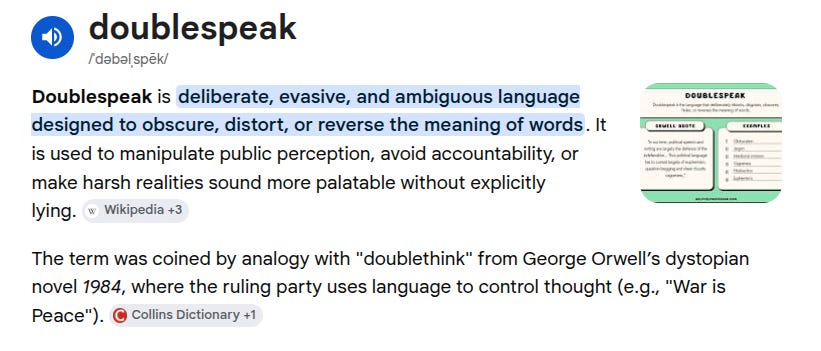
Notice how with all the talk of flattening and doing more with less, Armstrong didn’t mention democracy or holocracy? I don’t think there’s anything further from his mind. This isn’t the flattening from 2014, this is a new autocratic leadership powergrab that just coincidentally removes the same players from the board.
As George Orwell prophesized, authoritarians use pacifying language to distort meaning and distract naysayers while they assert control. It seems the real drive behind “the great flattening” isn’t as a democratizing force that frees up workers to do more of what they enjoy, but simply a consolidation of power and authority, making them not just leaders of their company, but the leader of the company. Unrestrained, unquestionable, unmatched.
This is the stuff that many CEOs dream of. These are people fueled by ambition and ego more than decency or common sense. They exist behind icebergs of ignorance, believing that they have the finger on the pulse when more often than not they are woefully uninitiated in the nuances of their corporate culture and the limits of their own influence. So I don’t think I’m off base to suggest that one of the primary drivers of the call to remove middle management is an immune response to the friction and frustration CEOs feel when things don’t seem to be moving fast enough or in the precise direction they imagined. In short, what they want is to exercise more veto power over decisions and a chance to micromanage whomever they want, whenever they want.
This is what is fueling the authoritarian fantasies of Jack Dorsey, who fully believes he can comfortably oversee 6000 direct reports. It comes from the same toxic wellspring that inspired Elon Musk to grind 18 hours straight to publicly interrogate every single employee at xAI for five (impotent) minutes. And it’s what motivated deplorable CloudFlare CEO Matthew Prince to brag about his recent round of layoffs like a warrior king who’s finally defeated all his enemies, using the kind of language that seems straight out of eugenics and white supremacy: going out of his way to further insult the legacy and contributions of laid off staff by denigrating them as “measurers and operators” versus the more highly prized “doers and builders” required by his new agenda. Good luck operating a company without…operators.
The same authoritarian streak can be seen in all the other CEOs recycling the “AI-first” memo recently, touting completely mythical claims about increased productivity as a smokescreen for right-sizing in response to downturns. It’s all an act of toxic bravado masking greed, ignorance, and fear. And some of these over confident copycats are already learning the hard way that talking and acting like a dictator and lying about the transformative power of AI doesn’t pay off, whether it’s public backlash, employee discontent, or painful lessons in AI token economics.
Where all this leads
There will be trouble ahead. A reckoning. A time for CEO’s like Prince and Armstrong to realize (hopefully too late) that by putting AI first and humans last, they destroy their own companies and never recover. If they continue to get business advice from chatGPT instead of their peers and friends, they’ll continue to make bigger and bigger mistakes, and sooner or later, customers, costs, or calamities will come for them. We can only hope.
Middle managers get a bad rap, and sometimes for good reason, but they provide necessary cover for frontline managers, and they are the operators who work behind the scenes to keep the ship afloat. You can’t just dismiss the leaders of strategy, finance, research, auditing, legal review, marketing, compliance, and operations and expect to keep merrily sailing along. At best you’re going to miss your targets. At worst, you’re going to jail.
Middle management can be a bottleneck, which means organizations should make sure they’re properly trained and that only the right candidates are promoted. It doesn’t mean you can just wave a magic wand and make them disappear and pretend it’s business as usual. I don’t believe these bloviating CEOs even believe what they’re saying. It’s all so much AI theater. And nobody’s clapping.
So true. Bureaucracy has unfortunately been reduced to a pure punching bag - it means slow. It means inefficient. It means mindless work and tedious interactions. But before it became a slur in a society swallowed whole by libertarian wish-fulfillment fantasies, it was a way to effectively manage complexity and solve problems in a focused way. Of course, the USA government was envisioned as having three 'branches' for accountability and balance as well.
I remember getting into a thing about the 'end of hierarchy' with senior leadership of the prominent tech company I worked for some yrs back. I showed some images of 'the tree' as a metaphor that has been around since the beginning of western culture, attempting to persuade them that there's something that just isn't going away in its value for humanity. They weren't having it.
Even despite the fact that the tree has yet to go out of style in many software design patterns.
Thanks for the depth you put into this.
I only can add bra-vo.
What is sad is that the ones paying all those mistakes are going to be the working class. Getting a job in IT has become the hunger games. And when all burst in a beautiful supernova is going to be worse.
We are all in the same boat if you depend in a salary as the main income source. But some people still think that they are in a yacht, not in a boat.
So naive...